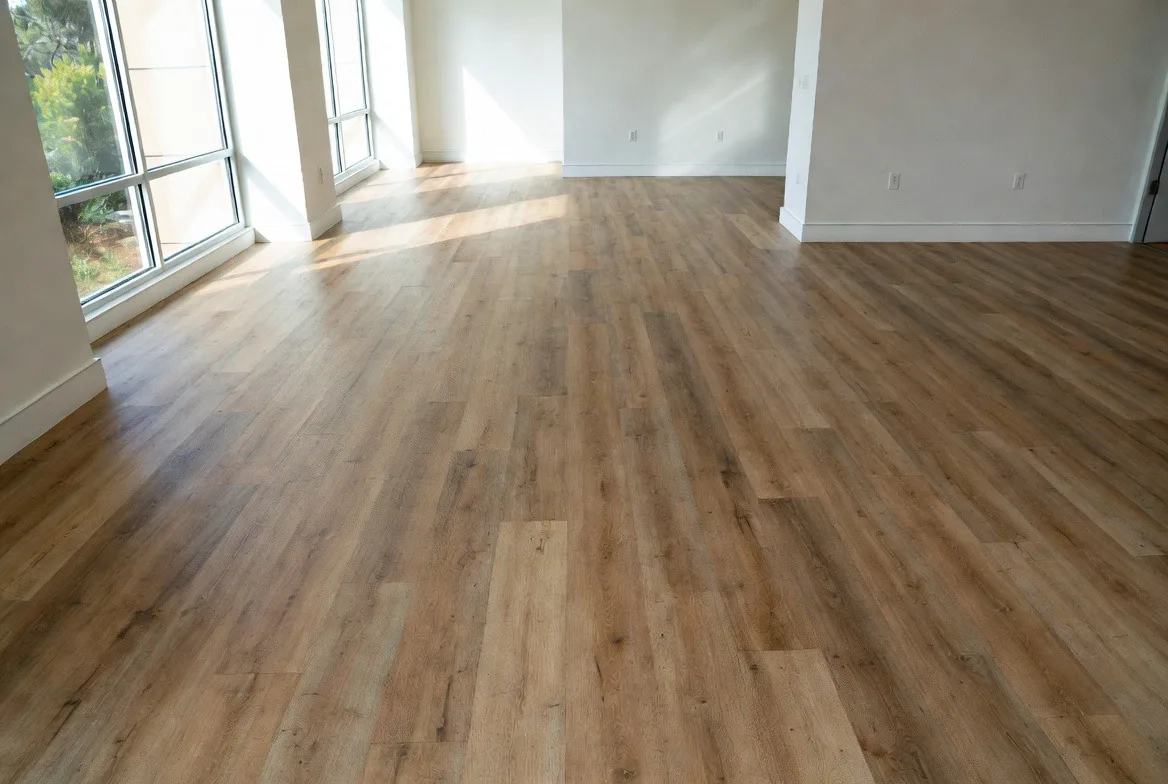
Published October 2026. Rates are Greater Toronto Area market ranges in Canadian dollars, before HST.
Short answer: resilient flooring is any floor that is firm but gives slightly under pressure and springs back. The family includes luxury vinyl plank and tile, vinyl sheet, VCT, Marmoleum and linoleum, and rubber. It tolerates water, is comfortable to stand on and is easy to clean, which is why it is the default in basements, kitchens, condos, schools and hospitals. Installed vinyl in the GTA typically runs $3 to $8.50 per square foot before prep and HST.
If you want a floor that shrugs off spilled drinks, slushy boots and a damp basement without the cost of tile or hardwood, resilient flooring is probably the answer. The catch is that the products in this family look alike in a showroom and behave very differently once they are down. This guide covers what each type is, where it works, what it costs, and what separates a floor that lasts twenty years from one that is lifting at the seams in two.
What “resilient” actually means
A resilient floor has a little give. Drop a pot on it and it is far less likely to crack or chip than ceramic. Stand on it through a long shift and it is easier on your feet and knees than stone or bare concrete. Roll a chair across it and the floor recovers.
That give comes from the material — vinyl, linoleum or rubber rather than wood, ceramic or stone. Most resilient floors share three traits:
- Water tolerance. Most types handle spills and humidity far better than hardwood or laminate.
- Comfort and quiet. Softer and quieter underfoot than tile, especially over a good underlay.
- Low upkeep. A sweep and a damp mop covers most of it. No sanding, refinishing or grout sealing.
The main types of resilient flooring
Five product families cover nearly every resilient floor you will be offered. Here is how they compare at a glance.
| Type | Water | Feel underfoot | Best for |
|---|---|---|---|
| Luxury vinyl (LVP / LVT) | Planks are waterproof; seams are the weak point | Firm; warmer over underlay | Kitchens, basements, condos, offices, retail |
| Vinyl sheet | Excellent; few or no seams | Soft, often cushioned | Bathrooms, laundry rooms, healthcare, rentals |
| Marmoleum / linoleum | Good with routine maintenance | Firm, slightly warm | Schools, healthcare, kitchens, green builds |
| VCT | Good; a seam every 12″ | Hard | Schools, retail, corridors, back-of-house |
| Rubber | Very good | Cushioned, grippy | Gyms, stairs, ramps, mudrooms, playrooms |
Luxury vinyl plank and tile (LVP / LVT)
This is what most people mean by “vinyl flooring” today: a backing layer, a vinyl core, a high-resolution photo layer and a clear wear layer on top. The wear layer does the real work — more on that below. It comes in two installation styles:
- Glue-down. Thinner planks bonded to the subfloor with adhesive. It cannot shift, gap or bounce, it handles rolling loads, and large open areas need no expansion breaks. It is what we install in almost every commercial space.
- Click / floating (rigid core). Thicker planks with a stiff SPC (stone plastic composite) or WPC (wood plastic composite) core that lock together over an underlay. Quicker to install and more forgiving of minor subfloor flaws, which keeps labour down on residential jobs.
Vinyl sheet
Sheet vinyl has come a long way from the curling kitchen floors of the 1980s. It goes down in wide rolls, so a typical room has one seam or none, leaving water almost nowhere to get through. In hospitals, labs and commercial kitchens the seams are heat-welded and the floor is coved up the wall, which turns the whole room into one sealed, cleanable surface.
Marmoleum and linoleum
Linoleum is often confused with vinyl, but it is a different material: linseed oil, wood flour, cork dust and limestone pressed onto a jute backing. Marmoleum is Forbo’s well-known linoleum line. It is naturally hard-wearing and, properly installed and maintained, commonly lasts 25 to 40 years. The trade-off is routine maintenance, and it is less forgiving of standing water than vinyl.
VCT (vinyl composition tile)
The 12″ square tile you have walked across in countless schools and grocery stores. VCT is one of the least expensive commercial floors to install and stands up to heavy traffic, but it needs a regular polish or wax programme to keep looking good. It is a commercial product; in a home, luxury vinyl does the same job with far less upkeep.
Rubber
Rubber absorbs impact and sound better than anything else on this list, and it stays grippy underfoot. That makes it the standard for gyms, stair treads, ramps and busy corridors — and a strong choice for a home gym or a mudroom that takes a beating every winter. Expect a rubber smell for the first few weeks after installation.
Where resilient flooring works best
Resilient flooring earns its keep in the rooms where hardwood and laminate struggle.
In homes
- Basements. Below grade, the floor has to tolerate moisture, which rules out solid hardwood and most laminate. Luxury vinyl, glue-down or click, is the usual choice once the slab has been tested.
- Kitchens. Spills, dropped dishes and constant traffic make luxury vinyl the go-to. Marmoleum is a durable, natural alternative.
- Bathrooms and laundry rooms. Fewer seams means less risk, so vinyl sheet is hard to beat. Plank works too if the perimeter is sealed at the tub, toilet and walls.
- Entryways and mudrooms. GTA winters bring salt, sand and slush through the front door. Choose a thick wear layer and a good mat, or go with rubber.
- Condos. Most buildings set a minimum sound rating for new floors, so the underlay matters as much as the plank. Check the rules with your management office before you buy; our installation day checklist covers the rest of the condo paperwork.
- Rentals and basement apartments. Durable, waterproof and cheap to repair between tenants. See the best flooring for rental units.
In commercial buildings
Resilient flooring is the default in most commercial space. Glue-down LVT suits offices and retail. Heat-welded vinyl sheet is the standard in healthcare, labs and food service, where the floor has to be sealed and cleanable. Marmoleum is a long-life favourite in schools, VCT remains a low-cost workhorse for corridors and stores, and rubber handles gyms, stairs and ramps. More on our commercial and property management work.
What resilient flooring costs in the GTA
For the main residential products, here are GTA installed rates split into material and labour — the same figures behind our basement cost guide. They cover material and standard installation only, not removal, levelling or HST.
| Product | Material | Labour | Installed |
|---|---|---|---|
| Vinyl sheet | $1–3 | $1–3 | $3–7 |
| Click / floating LVP (SPC) | $2.69–4.99 | $1.50–2.50 | $5.50–8.50 |
| Glue-down LVT / LVP | $3.50–4.99 | $2.50–3.50 | $6.50–8.00 |
Canadian dollars per square foot, before HST. Ranges reflect GTA contractor pricing published by Alexanian, Tony’s Flooring, Petun Flooring and RenoQuotes through 2025–2026.
Marmoleum, VCT and rubber are mostly specified for commercial jobs, and their price swings with the product line, thickness, seam welding and the size of the area, so we quote those per project.
The flooring itself is often not the biggest variable. These are the lines that move a quote:
- Subfloor condition. Levelling runs $2–4 per square foot over the area that needs it. See what floor prep actually costs in Ontario.
- Removal. Carpet comes up for $0.50–1.50 per square foot; hardwood, laminate or vinyl $1–3; ceramic $2–5.
- Stairs. Priced per step, typically $30–80 each.
- Trim. Baseboard and quarter round run $2.00–4.50 per linear foot.
- HST. Ontario’s 13% applies to labour and materials alike.
For a full worked example with prep, stairs and tax, see how much it costs to floor a basement in Ontario.
Why installation matters more than the product
Most resilient floor failures trace back to the prep, not the plank. Gapping seams, peaking joints, hollow spots and lifting edges are almost always installation problems. A proper install gets five things right:
- Moisture testing. On concrete, the slab is tested before anything goes down. ASTM F2170 in-situ relative humidity testing sets the ceiling at 75% RH unless the adhesive manufacturer permits more, and a slab that feels dry can still test well above that.
- A flat subfloor. ASTM F710 calls for concrete to be flat within 3/16″ over 10 feet. High spots are ground and low spots filled with patch or self-levelling compound. Skip it and dips telegraph through thin vinyl, or click joints flex until they break. Our floor prep page explains the process.
- Acclimation. The material sits in the space at normal living temperature for as long as the manufacturer specifies, typically 24 to 48 hours.
- The right method for the room. Glue-down for commercial space, rolling loads, large open areas and sun-heated rooms where a floating floor would move. Click for most residential rooms, where speed and cost matter and the space is within the manufacturer’s size limits.
- The details. Expansion gaps on floating floors, transitions at doorways, silicone at tubs and toilets, and trim fitted so the floor can still move.
Manufacturer warranties almost always require installation to their written standards, and installing over a wet slab is the most common reason a claim is denied. A shortcut on prep can void the warranty along with the floor.
How to choose: a buyer’s checklist
Two floors can look identical in the showroom and perform very differently. Check these before you buy:
- Wear layer. Measured in mil (thousandths of an inch), not millimetres. Look for at least 12 mil in most homes and 20 mil or more for pets, kids, rentals, entryways and commercial use. It is not the same as total plank thickness.
- Core. For click floors, SPC is denser and more dent-resistant; WPC is softer and quieter underfoot.
- Underlay. Many click planks have it attached. Don’t add a second layer unless the manufacturer allows it, or the joints can fail. In a condo, confirm it meets your building’s sound rating.
- Waterproof versus water-resistant. A waterproof plank is not a waterproof floor. Water can still find its way through seams and edges into the subfloor.
- Indoor air quality. Look for FloorScore certification and phthalate-free products, especially for bedrooms, daycares and schools.
- Warranty fine print. “Lifetime” residential warranties usually cover manufacturing defects and wear-through, not scratches, sun fading or installation problems. Ask your installer for a labour warranty in writing.
- Overage. Order 5–10% extra for a straight lay and 10–15% for diagonal or pattern work, and keep a spare box from the same production lot for future repairs.
Getting the right floor, installed right
The best resilient floor is the one matched to your space, your subfloor and how the room is used, then installed to the manufacturer’s standard. We install every product in this guide across the GTA, including Toronto, Mississauga and Vaughan. We will measure the space, check flatness and test for moisture at no charge, and the quote comes back itemised. Request a free quote or call or text 416-889-8273.